What Is OneCoin? The Deep Dive

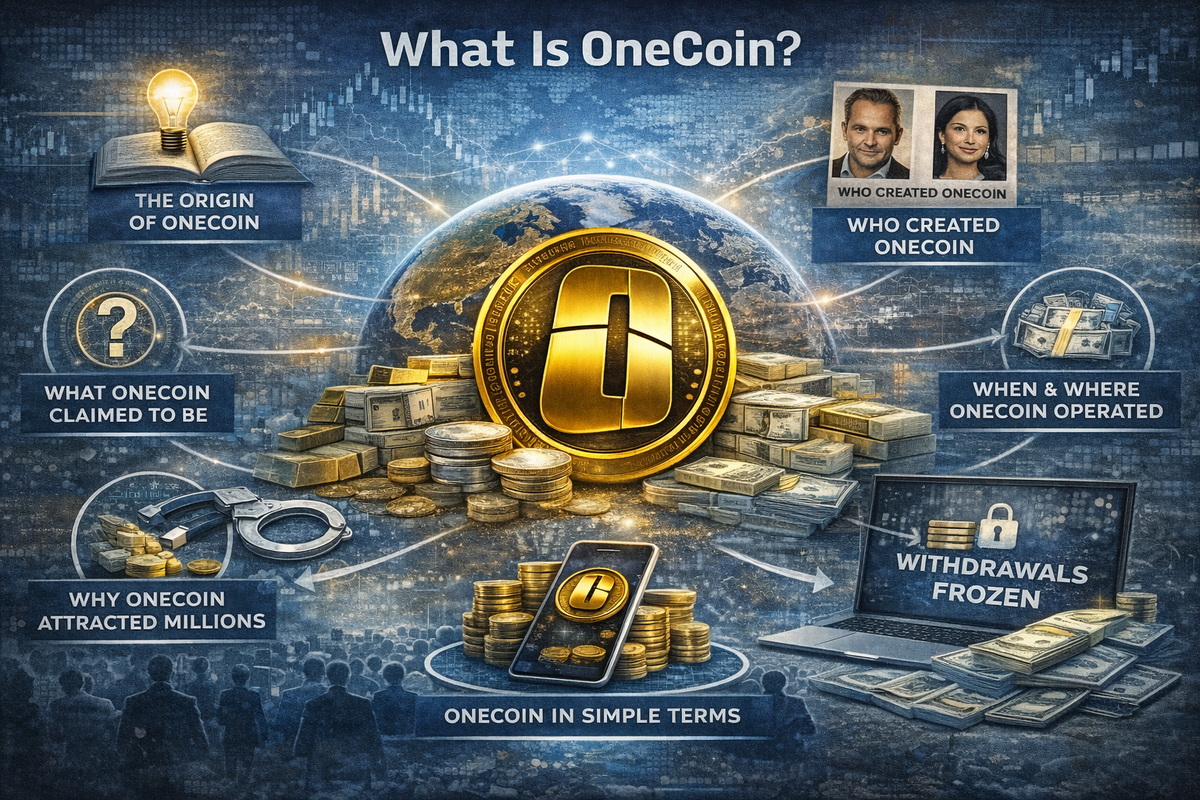
When OneCoin was introduced to the world in 2014, it was presented as a breakthrough in digital finance, a cryptocurrency designed to rival Bitcoin and bring wealth and financial opportunity to millions.
Its founders spoke the language of innovation, decentralization and inclusion, promising a new form of money that would be easier to use, more accessible and more profitable than anything that had come before.
Within a few short years, OneCoin had spread across continents, attracted millions of participants, and generated billions of dollars in revenue. Yet behind the polished presentations and ambitious claims, the project lacked the fundamental elements of a real cryptocurrency. What OneCoin offered was not a technological revolution, but a carefully constructed illusion, one that would ultimately collapse under regulatory scrutiny and criminal investigation.
The Origin of OneCoin
OneCoin emerged in the aftermath of Bitcoin’s rise, at a time when cryptocurrencies were gaining mainstream attention but remained poorly understood by much of the public. Launched in 2014 through a network of offshore companies, including entities registered in Dubai and Belize, OneCoin positioned itself as the next evolution of digital currency.
The project was promoted aggressively from the outset, relying on large-scale events, motivational messaging, and an expanding network of regional promoters. Unlike Bitcoin, which grew organically through open-source development and public adoption, OneCoin was introduced as a packaged opportunity, something people had to buy into in order to participate.
Who Created OneCoin?
At the center of OneCoin was the notorious Ruja Ignatova, a Bulgarian-born entrepreneur with a background in law and consulting. She presented herself as a visionary leader with the expertise to build a global financial system and quickly became the public face of the project. Her confident stage presence and polished speeches earned her the nickname “the Cryptoqueen” among supporters.
Ignatova co-founded OneCoin with Karl Sebastian Greenwood, who played a key role in designing the project’s global marketing and compensation structure. Greenwood focused on building a vast multi-level marketing network that rewarded recruitment and sales, enabling OneCoin to expand rapidly across borders.
What OneCoin Claimed to Be
OneCoin claimed to be a cryptocurrency powered by blockchain technology, comparable to Bitcoin but superior in speed, scalability, and usability. Promoters told audiences that OneCoin would soon be used for everyday transactions and become a widely accepted global currency.
Charts and comparisons were frequently used to position OneCoin alongside legitimate cryptocurrencies, reinforcing the perception that it operated on similar technical foundations. However, unlike Bitcoin and other decentralized currencies, OneCoin never provided public access to its blockchain or transaction data, a critical distinction that would later prove central to investigations.
When and Where OneCoin Operated
Between 2014 and 2017, OneCoin operated on a global scale. Promotional events were held across Europe, Asia, Africa and Latin America, drawing large crowds and significant media attention. By some estimates, more than three million people worldwide participated in the scheme.
OneCoin’s international reach was made possible by its decentralized sales structure. Local promoters organized events, recruited new members and facilitated purchases, allowing the project to grow rapidly while avoiding sustained oversight from any single regulator.
Why OneCoin Attracted Millions
OneCoin’s appeal lay in a combination of timing, messaging and social dynamics. Cryptocurrency was widely seen as a path to rapid wealth, but many people felt they had missed the early gains of Bitcoin. OneCoin promised a second chance an opportunity to get in early on the next major digital currency.
The system also removed technical barriers. Participants did not need to understand blockchain technology, manage digital wallets, or trade on exchanges. Everything was handled within OneCoin’s internal platform, making participation seem simple and accessible.
Recruitment through personal networks further reinforced trust. Friends, family members, and community leaders often acted as promoters, lending credibility to the project and accelerating its spread.
What OneCoin Promised Investors
Although OneCoin avoided explicitly calling itself an investment, the promise of financial gain was central to its messaging. Participants were encouraged to believe that OneCoin’s value would rise steadily and that early adopters would benefit the most.
Promoters spoke frequently about future exchange listings, global adoption, and long-term wealth. Internal dashboards displayed rising coin values, reinforcing confidence and encouraging participants to invest more or recruit others. These promises, however, were not supported by open market trading or independent valuation mechanisms.
In simple terms, OneCoin operated as a closed system. People paid real money to purchase education packages that included tokens, which could be converted into OneCoins inside the company’s platform. The coins had no existence outside this system and could not be freely traded on public exchanges.
The appearance of growth was maintained through internal accounting, controlled pricing, and continuous recruitment rather than through genuine technological innovation or economic activity. As long as new participants continued to join, the system appeared to function.
OneCoin was presented as a revolutionary cryptocurrency, but it lacked the transparency, decentralization and public verification that define legitimate digital currencies. Its somewhat success was driven not by technology, but by marketing, recruitment and the promise of financial opportunity.