U.S. Convictions Cement OneCoin as One of the Largest Crypto Frauds (2022)

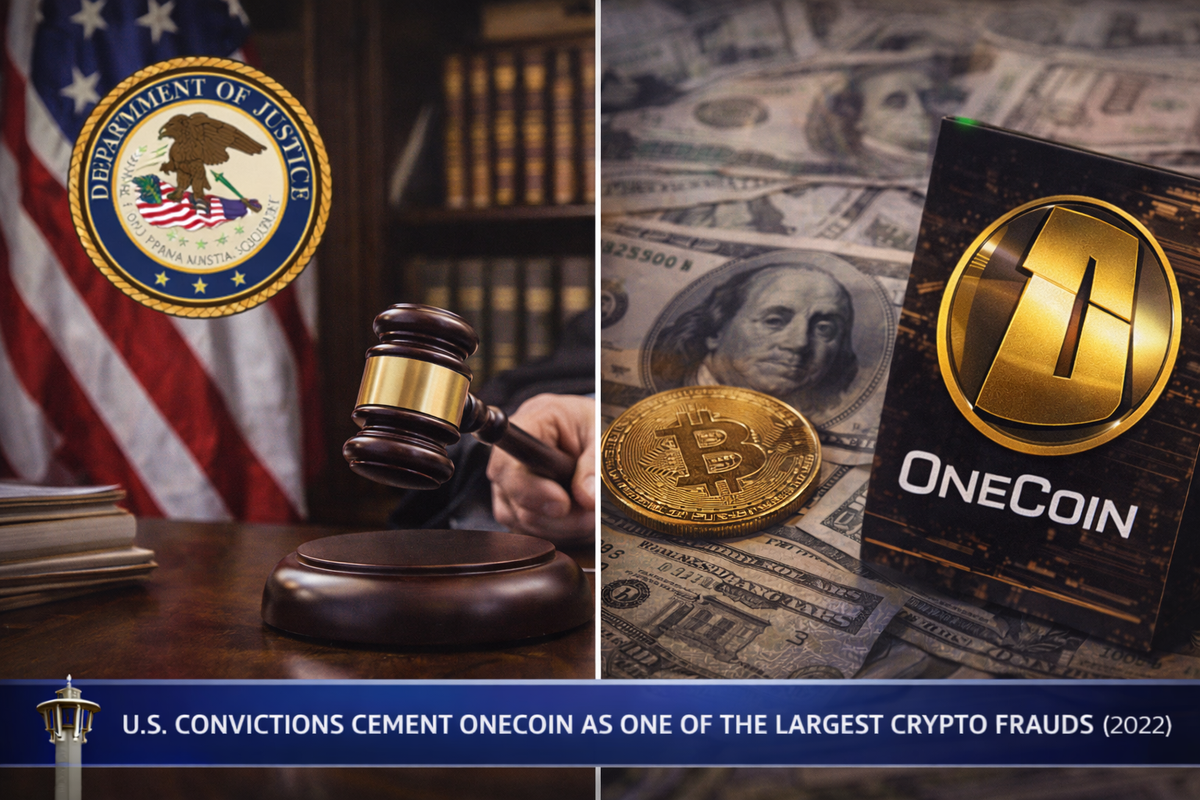
By 2022, the legal reckoning for OneCoin had reached a decisive stage. A series of convictions in U.S. federal court confirmed what regulators, investigators, and victims had long alleged: OneCoin was not a failed cryptocurrency experiment, but one of the largest and most consequential financial frauds ever linked to the digital asset sector.
The convictions followed years of investigation by U.S. prosecutors, particularly in the Southern District of New York, who pursued charges including wire fraud, conspiracy, and money laundering against key figures associated with OneCoin. Court findings established that the scheme had generated billions of dollars from millions of participants worldwide through systematic deception.
Judges reviewing the evidence emphasized the scale and organization of the operation. Testimony and financial records demonstrated that OneCoin’s leadership knowingly misrepresented the existence of a blockchain, manipulated internal coin values, and used recruitment-driven incentives to sustain cash inflows. These practices, the courts found, were designed to enrich insiders rather than build a legitimate financial product.
The convictions relied heavily on evidence uncovered during earlier phases of the case. Financial tracing showed how investor funds were routed through offshore entities, while cooperating witnesses provided insider accounts of decision-making at the highest levels of the organization. Together, this evidence painted a picture of a centrally controlled scheme masquerading as decentralized technology.
For prosecutors, the outcomes represented a validation of a long and complex investigation. Officials noted that the OneCoin case demonstrated the ability of existing financial crime laws to address fraud conducted under the guise of emerging technology. The use of cryptocurrency terminology, they argued, did not place perpetrators beyond the reach of traditional enforcement tools.
The rulings also had broader implications for the cryptocurrency industry. Regulators and policymakers cited the OneCoin convictions as proof that innovation claims must be backed by transparency and verifiable technology. The case was increasingly referenced in enforcement actions and public advisories warning consumers about high-yield crypto schemes and unregulated investment opportunities.
Victims followed the convictions closely, viewing them as long-awaited acknowledgment of wrongdoing. While criminal judgments did not guarantee full restitution, they provided official recognition that investors had been misled. Courts acknowledged the extensive financial harm caused, even as they cautioned that asset recovery would be limited by the dissipation of funds over time.
Legal analysts described the OneCoin convictions as a landmark moment in cryptocurrency enforcement. Unlike cases involving isolated actors or small-scale frauds, OneCoin represented a global operation that relied on coordinated marketing, complex financial structures, and the strategic misuse of technology narratives. The successful prosecutions underscored the importance of international cooperation and persistence in addressing such schemes.
By the end of 2022, the narrative surrounding OneCoin had shifted permanently. The question was no longer whether the project was fraudulent, but how the consequences would continue to unfold through sentencing, civil litigation, and ongoing efforts to locate remaining assets and individuals involved.
The U.S. convictions cemented OneCoin’s place in financial history as a cautionary tale. They reinforced the lesson that while technology evolves rapidly, the principles of fraud remain constant—and that large-scale deception, even when wrapped in the language of innovation, can ultimately be exposed through sustained legal scrutiny.