The OneCoin Business Model Explained: Moving Money Through the Scheme


While OneCoin was marketed as a cutting‑edge cryptocurrency, its real engine was not technology but a carefully constructed business model built around recruitment, commissions and continuous inflows of new money.
Understanding this model is essential to understanding how OneCoin grew so rapidly and why it ultimately collapsed.
At its core, OneCoin operated less like a financial innovation and more like a global multi‑level marketing operation. Revenue did not come from trading, payments, or genuine economic activity. Instead, it came overwhelmingly from people buying into the system and encouraging others to do the same. Court filings, regulatory warnings, and later testimony from insiders all point to the same conclusion: OneCoin’s business model depended on a constant stream of new participants to sustain payouts to earlier ones.
How OneCoin Made Money
OneCoin’s primary source of revenue was the sale of so‑called “education packages.” These packages, priced from a few hundred euros to well over €100,000, were sold to individuals who believed they were gaining access to a future digital currency opportunity. While marketed as educational products, their real value to buyers lay in the tokens bundled with them — tokens that could be converted into OneCoins within the company’s internal system.
According to U.S. prosecutors, billions of dollars flowed into OneCoin through these package sales, generating massive revenue for the company and its top promoters (U.S. Department of Justice). There was no meaningful external source of income. The system did not generate revenue through trading fees, transaction processing, or merchant adoption in the way legitimate cryptocurrencies do.
Recruitment and the Multi‑Level Marketing Structure
OneCoin’s expansion relied heavily on a multi‑level marketing (MLM) structure. Participants were encouraged not only to purchase packages themselves but to recruit others into the network. Those recruits, in turn, were incentivized to bring in additional members.
This structure created multiple layers of participants, with commissions flowing upward through the network. The more people a participant recruited, directly or indirectly the more potential commissions they could earn. Internal presentations emphasized building teams, advancing ranks, and expanding downlines, language familiar to anyone with experience in MLM organizations.
Recruitment was framed as an opportunity rather than a requirement, but in practice it was the primary way participants could hope to recover or grow their initial outlay.
Bonuses, Ranks, and Incentives
To encourage aggressive recruitment, OneCoin implemented a system of ranks, bonuses, and rewards. Participants who reached certain sales or recruitment thresholds were awarded titles, cash bonuses, and lifestyle incentives such as luxury trips and cars.
These rewards were showcased prominently at company events, reinforcing the perception that success was both achievable and common. According to court records, top promoters earned millions of dollars in commissions, often funded directly by the purchases made by new recruits entering the system.
The rank system also served a psychological purpose: it encouraged participants to reinvest earnings, upgrade to higher‑priced packages, and maintain belief in the system even as warning signs emerged.
Why Recruitment Was Central to Growth
Recruitment was not a secondary feature of OneCoin’s business model it was central to its survival. Because the company did not generate revenue from external markets, new money entering the system was required to pay commissions, bonuses, and withdrawals promised to existing participants.
As long as recruitment continued to grow, the system could appear healthy. When recruitment slowed, pressure mounted. Internal restrictions on withdrawals, delays on internal exchanges, and increased emphasis on recruitment often followed, according to participant accounts and investigative reporting.
This dependency on continuous recruitment is one of the defining characteristics of pyramid and Ponzi‑style schemes, a comparison later made explicitly by prosecutors and regulators.
The Flow of Money Inside OneCoin
Money paid by new participants did not flow into a shared investment pool or into technology development in any transparent way. Instead, funds were distributed across a complex network of corporate entities and accounts controlled by OneCoin’s leadership.
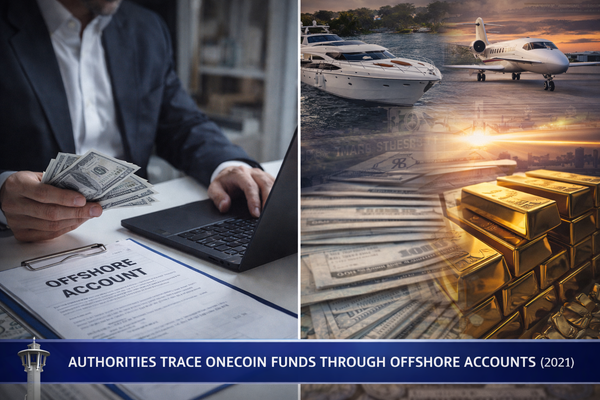
Court documents allege that large portions of incoming funds were used to pay commissions to promoters, finance lavish marketing events, and enrich company executives. Some money was routed through offshore accounts and shell companies, complicating efforts by authorities to trace and recover assets.
The lack of transparency meant participants had no visibility into how their money was being used or whether it was generating any legitimate economic value.
How Promoters Earned Commissions
Promoters earned commissions based on the value of packages sold within their recruitment networks. The larger and deeper the network, the higher the potential payout. This created powerful incentives to recruit aggressively and to encourage new participants to purchase the most expensive packages available.
Top‑level promoters were often presented as proof of OneCoin’s legitimacy and success. Their earnings, however, were tied directly to the inflow of new money rather than to the performance of any underlying asset or technology.
According to prosecutors, some of the highest‑ranking promoters earned tens or even hundreds of millions of dollars before the scheme collapsed, while later participants struggled to recover any funds.
Why New Investors Paid Old Ones
In practical terms, money from new investors was used to fund payouts to earlier participants. Withdrawals, bonuses, and commissions were not generated by profits from trading or real economic activity but by fresh inflows of capital.
This structure allowed the system to function as long as growth continued, but it also meant that losses were inevitable once recruitment slowed or stopped. Those who joined later bore the greatest financial risk, while early promoters and insiders were able to extract substantial sums.
This pattern, early participants being paid with money from later ones, is a hallmark of Ponzi‑style schemes and was central to the case brought by U.S. authorities against OneCoin’s leadership.
The OneCoin business model was built on recruitment, not innovation. While wrapped in the language of cryptocurrency and financial education, its revenue depended almost entirely on convincing new participants to buy into the system.