Authorities Trace OneCoin Funds Through Offshore Accounts (2021)

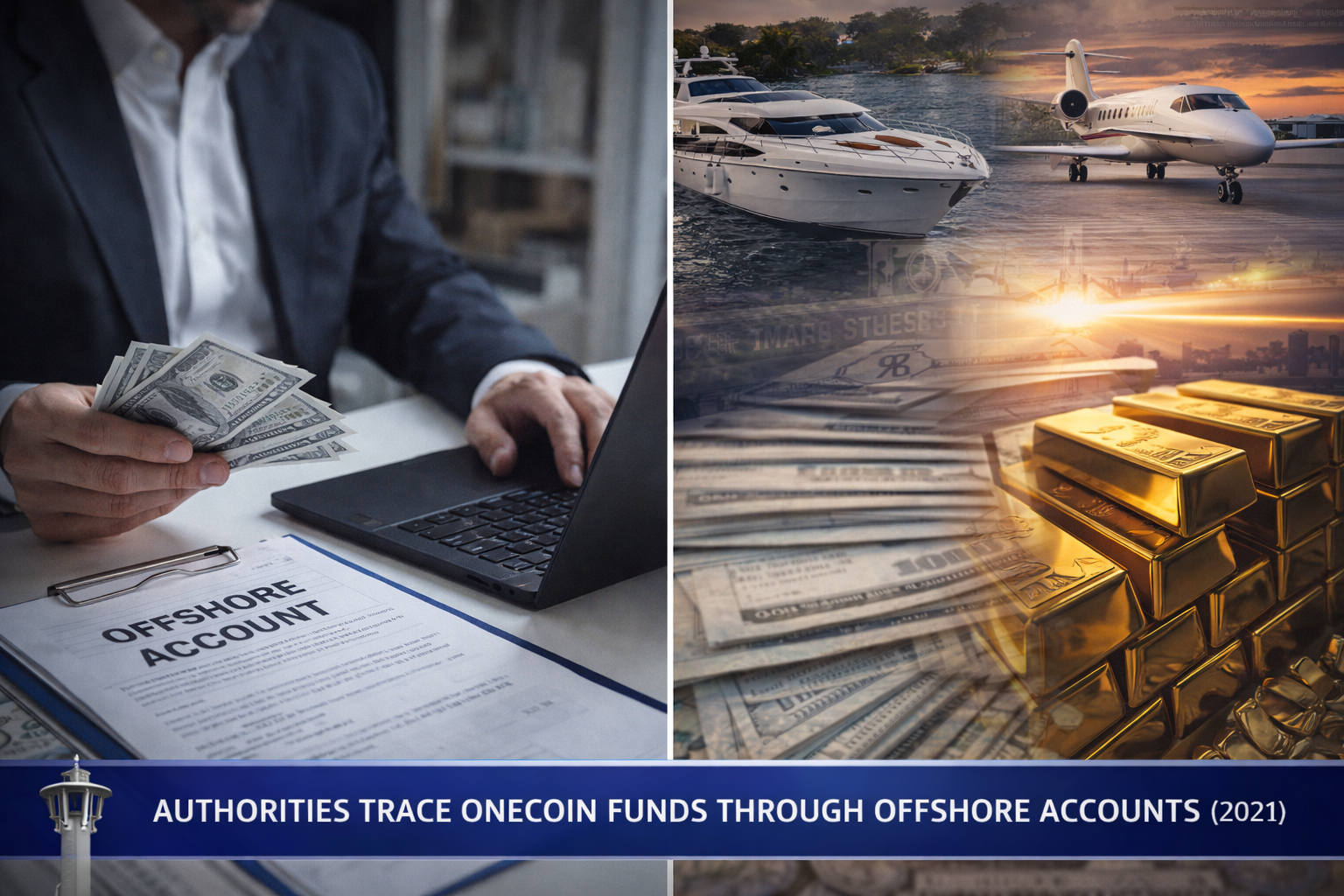
In 2021, investigators revealed new details about how billions of dollars generated by the OneCoin scheme were moved, concealed, and spent. Court filings and public statements from prosecutors outlined an extensive financial trail that led through offshore accounts, shell companies, and luxury assets, underscoring the complexity of the operation and the challenges facing recovery efforts.
According to prosecutors, OneCoin’s leadership relied on a web of international bank accounts and corporate entities to obscure the origin of funds paid by participants. Money collected from education packages and related fees was allegedly routed through jurisdictions with limited transparency, making it difficult for authorities to trace transactions in real time. These structures, investigators said, were designed to frustrate regulators and delay detection.
Court documents described how proceeds were transferred between accounts held in the names of shell companies, often across multiple countries in rapid succession. This layering process is a common feature of money laundering schemes, intended to break the direct link between criminal activity and the ultimate beneficiaries. In the OneCoin case, prosecutors alleged that such techniques were used on a massive scale.
Investigators also detailed how portions of the funds were spent on high-value assets. Evidence presented in court referenced luxury real estate, expensive vehicles, and other personal expenditures allegedly financed with OneCoin proceeds. These purchases, prosecutors argued, illustrated how investor money was diverted away from any legitimate business purpose.
The tracing of funds was aided in part by cooperation from former OneCoin insiders who had pleaded guilty earlier in the year. Their testimony helped authorities identify key accounts and transactions, providing context for financial records obtained through subpoenas and international legal assistance requests. This insider cooperation allowed investigators to reconstruct aspects of the scheme that had previously been hidden.
Despite these advances, officials acknowledged that recovering the full amount lost by victims would be extremely difficult. Much of the money had been moved repeatedly, spent, or placed beyond the reach of immediate seizure. Asset recovery efforts were further complicated by differences in legal standards across jurisdictions, particularly where funds were held in countries with strict banking secrecy laws.
European authorities were also involved in tracing efforts, sharing intelligence and financial data with U.S. prosecutors. This cooperation reflected the cross-border nature of the OneCoin scheme and the necessity of international collaboration to address large-scale financial crime. Investigators emphasized that no single agency could unravel the operation alone.
For victims, the revelations in 2021 were both validating and sobering. While the disclosures confirmed that funds had been systematically misappropriated, they also highlighted the limited prospects for full restitution. Legal experts noted that even successful criminal prosecutions do not guarantee meaningful recovery in cases involving extensive offshore laundering.
The tracing of OneCoin funds marked another critical step in the case. It demonstrated how the scheme’s financial architecture was deliberately designed to conceal wrongdoing and reinforced the seriousness of the charges brought against its leaders. The findings also served as a warning to regulators and financial institutions about the vulnerabilities that can be exploited in global payment systems.
By the end of 2021, authorities had mapped significant portions of the OneCoin money trail, providing courts with a clearer picture of how the fraud operated behind the scenes. These efforts laid the groundwork for subsequent sentencing decisions and informed ongoing discussions about improving oversight and cooperation to combat international financial crime.